Category: African Diaspora History Searches

  • A Brush with History: My 1977 Encounter with Alex Haley

    A Brush with History: My 1977 Encounter with Alex Haley

    It was pure serendipity. In 1977, while I was a sophomore at Clark College (now Clark Atlanta University) in Atlanta, I obtained a cherished autograph from a U.S. Coast Guard veteran turned legendary journalist and author: Alex Haley, the man who penned Roots: The Saga of an American Family. 
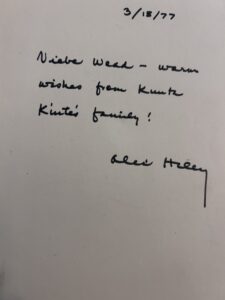
    Autograph from Alex Haley
    Handwritten note from Alex Haley to Nieve Wead

    My middle name, Lineve, was shortened into the nickname “Nieve,” which is how Haley addressed me in his note. Just a month after our encounter, he received a Pulitzer Prize, earning a special citation for Roots as “the story of a Black family from its origins in Africa through seven generations to the present day in America.”
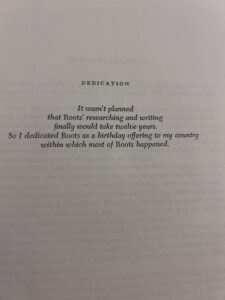
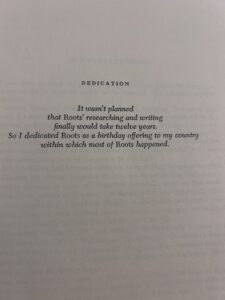
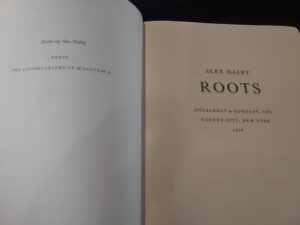
    Roots title pageROOTS

    The Phenomenon of Roots

    Today, there are few people who haven’t heard of, read, or watched Haley’s deeply moving masterpiece. Released in 1976, Roots spent a staggering 46 weeks on the New York Times Bestseller list.

    The novel chronicled the life of Kunta Kinte, an 18th-century Mandinka man captured in his West African homeland and trafficked to North America. From there, it took readers through the painful, violent, yet remarkably resilient lives of Kunta Kinte’s descendants in the United States. What made the book so revolutionary at the time was the revelation that these descendants included Haley himself.

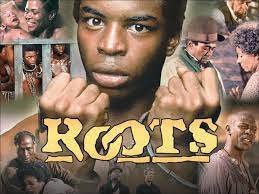
    Haley was a prolific researcher and writer. His massive literary success didn’t stop with the original book and its groundbreaking initial television adaptation with the Roots Miniseries that aired in January 1977.  For eight consecutive nights in my dormitory, Merner Hall, on Clark College’s campus, we were tuned into the impactful video story of our new champion family. I recall how I vowed to follow Alex Haley’s path in locating my long-lost family in Africa and other places around the world. The final chapters of his story were later adapted into the 1979 TV miniseries, Roots: The Next Generations.
    Inspiration Amid Controversy

    Like thousands of people around the world, I was instantly inspired to research my own African American genealogy. However, the book’s massive success also brought intense scrutiny. A highly regarded historian challenged Haley’s findings, claiming he could not have located the exact village where Kunta Kinte was born. In response to the widespread criticism, Haley gracefully defended his work by reminding the public that he had written a “factional” or “historical novel”—a blend of deep historical research and narrative storytelling.

    Looking back, the lessons I learned from that moment as a college student were numerous:

    • Respect the Grind: Always respect and give credence to the grueling, lengthy work of genealogical researchers, writers, and producers.
    • Trust, but Verify: This is always the order of the day for genealogists, especially those of us engaged in African Diaspora research.
    • Context Matters: The timing of Roots was incredibly noteworthy, arriving just as Jimmy Carter was inaugurated as U.S. President in January 1977, a time of profound national reflection.
    • Endless Stories: There are millions of stories waiting to be uncovered that allow us to accurately piece together our African Diaspora ancestry.

    My 30-Year Nudge

    Pictured below is my original copy of Roots. As you can see, I simply wore it out from reading and re-reading it so many times.

    While Alex Haley gave me the inspiration to vigorously research my family’s roots back in 1976, it ultimately took me 30 years to act on that great nudge. Today, I can proudly boast several hundred newly discovered family members on our family tree. My family tree now stretches back 13 generations across both my maternal and paternal sides, tracing our lines through Switzerland, Africa, Ireland, Germany, Missouri, Mississippi, Georgia, Virginia, North Carolina, and beyond.

    The journey takes time—but the reward is looking history right in the face.
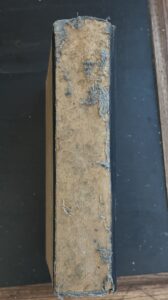
    My worn off book binding from the Roots book

  • Extra Extra! One of My Favorite Places to Search African Diaspora Ancestry

    Extra Extra! One of My Favorite Places to Search African Diaspora Ancestry

    One of my favorite places to search for African Diaspora ancestry is the U.S., African American Newspapers, 1829 – 1947 collection. It is one of the few research sources where I willingly become distracted.

    I often begin with a specific objective—a person, a family, or another subject that needs solving. Yet often I find myself reading entire newspaper pages. The articles, advertisements, editorials, and community announcements provide a rich understanding of the times in which our ancestors lived.

    Sometimes the most valuable discoveries have nothing to do with the individual I originally set out to find.

    A Unique “Census” for Black Folk

    The African American newspaper collection serves as a critical research center for locating information about African Diaspora relatives who can otherwise be difficult to trace through traditional records. More importantly, these newspapers reveal how Black individuals and communities lived, worked, worshipped, celebrated, and persevered during some of the most challenging periods in American history.

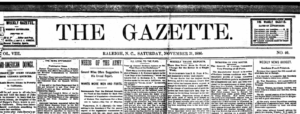
    While researching the life of Rev. LeGrand Lee “L.L.” Thomas (born September 1865 in Bishopville, South Carolina, and died April 13, 1917, in Manning, South Carolina), I encountered several fascinating articles in  The Gazette on Nov. 21, 1896.

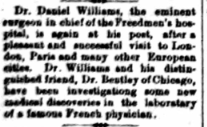
    One brief article reported that pioneering physician Dr. Daniel Hale Williams was traveling to Europe with another Black physician to study medical advancements.

    In just a few lines, I learned two important facts. First, Dr. Williams was serving as chief of Freedmen’s Hospital (now Howard University Hospital) . Second, he was traveling internationally in pursuit of medical knowledge and professional development. Those details transformed him from a historical name into a living; ambitious professional engaged with the wider world.

    Other articles in the same issue contained a complete listing of Black attendees at a “Colored State Fair” near Raleigh, North Carolina. To a genealogist, such a list can function almost like a community census, documenting individuals who may not appear elsewhere in records of the era.

    Then another article captured my attention.

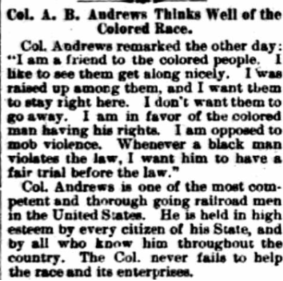
    “Col. A.B. Andrews Thinks Well of the Colored Race”

    The headline alone was enough to stop me.

    The article was not an advertisement. Instead, it appeared among reports about the Colored State Fair and other community news. Naturally, I wondered why a former Confederate colonel would feel compelled to publicly express such sentiments in a Black newspaper.

    Researching Col. A.B. Andrews did not fully answer my question, but I did learn that he:

    • Served as a Confederate cavalry officer;
    • Worked as a railroad executive;
    • Was trained as an engineer before the Civil War;
    • Saw active battlefield service; and
    • Contributed significantly to North Carolina’s transportation network after the war.

    Although his motivations remain unclear, the article offered a fascinating glimpse into the complex racial and social dynamics of the late nineteenth century.

    Why the Black Press Matters

    Beginning with the founding of Freedom’s Journal in 1827, hundreds of Black newspapers chronicled the lives, aspirations, achievements, migrations, and struggles of African Americans.

    Period Approximate Number
    Before the Civil War (1827–1861) About 30 Black newspapers were established. (OUPblog)
    By 1880 About 30 Black newspapers were operating nationally. (The New Yorker)
    By the start of World War I (1914–1917) Around 300 Black newspapers were being published. (The New Yorker)
    Entire history of the Black press More than 3,000 African American newspapers, magazines, and presses have existed since 1827. (Encyclopedia)

    For family historians and professional genealogists, these newspapers preserve stories and personal details that often cannot be found elsewhere. I grew up in Omaha, Nebraska and Chicago, Illinois. I was fortunate that the weekly Omaha Star newspaper was my anchor as a young person who longed to read news about Black people in my community and around the world. The same was true of the Chicago Defender newspaper, an iconic brand in the African American newspaper sector. I am fortunate to brag that I have published articles in both of these historic, dynamic papers that well-serve and served our communities.

    By the beginning of World War I, approximately 300 Black newspapers were being published throughout the United States. Over the course of U.S.  history, more than 3,000 Black newspapers, magazines, and presses have existed.

    These sacred publications documented:

    • Births and deaths;
    • Athletic feats;
    • Marriages and anniversaries;
    • Church activities;
    • School achievements;
    • Business ventures;
    • Military service;
    • Social events;
    • Community leadership; and
    • Migration patterns.

    For many African American families, Black newspapers preserve the only surviving evidence that an ancestor lived, worked, worshipped, or contributed to a community.

    A Funny Thing Happened on the Way to the Search

    I eventually located the information I sought regarding Rev. Thomas’s wife. However, the search produced much more than I expected.

    Because Rev. Thomas was a well-known minister in the Raleigh community, the newspaper references extended far beyond him. The searches revealed family members, church activities, community events, and social networks connected to his life.

    Once again, the lesson was clear. Sometimes we search for one person and discover an entire community.

    That is the beauty of African Diaspora genealogy research. The records do not simply tell us where our ancestors lived. They tell us how they lived. Occasionally, we are introduced to people and stories we never expected to find.


    zza


  • The Sensitive Plant at Ghana’s Last Bath

    The Sensitive Plant at Ghana’s Last Bath

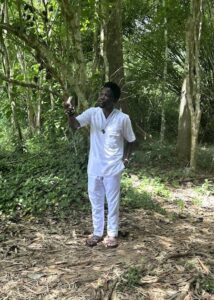
    Our prolific tour guide, Devine at the Last Bath, Assin Manso, Ghana
    Our prolific tour guide, Devine at the Last Bath, Assin Manso, Ghana


    It was an unexpected discovery along the winding, sometimes muddy path leading to what is solemnly known as the Last Bath in Ghana.

    Just moments earlier, our guide, Devine, was sharing rhythmic and powerful stories of survival of the men and women whose lives were violently uprooted centuries ago and forced toward an uncertain future across the Atlantic Ocean. His voice carried through the trees as he recounted the journeys of those who passed through this place in chains.

    Then, as Devine’s leather sandals were striding down the lightly muddy path, he stopped.

    The World’s “First” Security System

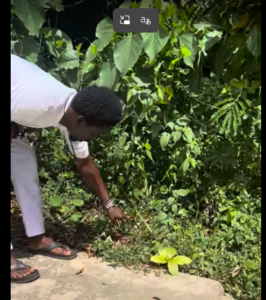
    Kneeling beside a place in the path, he pointed to a small patch of greenery and invited several of us to gather around.

    “This,” Devine said with a comforting smile, “was the first security system.”

    With the gentle touch of his finger, the tiny plant immediately recoiled. Its delicate leaves folded inward as though retreating from the world. Devine explained that the plant, commonly known as the Sensitive Plant (Mimosa pudica), would slowly reopen several minutes later. According to the stories that he shared, the plant’s sudden movements was an alert system for those who may have “disturbed the area.”

    “It was a secret system the ancestors used to protect their lands. We still have it here.” He said that if it were not for the grass that has grown up around the special plants, the visitors would be walking on the Sensitive Plant on the way to the actual river of the Last Bath.

    “They know that they have seven minutes to catch up with them. After seven minutes it opens back fully and they lose the trail,” explained Devine.

    He said the ancestors “were using it as their secret motion sensors. Whenever the ancestors came out to see the plant closed, they knew that something” been there. There is nothing on this earth that is invented by anyone else. Today, you are seeing the proof of our intelligence”.

    He referred to the plants as being the equivalent to the modern Ring Door security device: “The most amazing thing is that the security system itself was invented by an African American woman.” He was referring to Marie Van Brittan Brown, an African American nurse, co-invented the first home security system in 1966 with her husband, Albert L. Brown, an electronics technician.

    The demonstration lasted only a few seconds, but its symbolism lingered much longer.

    Standing at Assin Manso’s Last Bath, a place where countless Africans endured unimaginable loss before beginning the final stage of their forced journey to the coast, I could not ignore the metaphor. Generations of African Diaspora families have carried memories that folded inward for protection. Through genealogy, oral history, and return journeys to places such as Ghana, those memories slowly begin to open again.

    The Last Bath

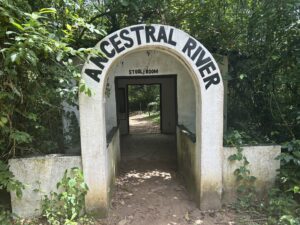
    More than 100 miles from Accra, Ghana’s capital city, lies the community of Assin Manso, home to one of the most emotionally significant sites in Ghana’s remembrance landscape. Located within the Assin Manso Ancestral Slave River Park, the Last Bath marks one of the final inland transfer points for many enslaved Africans before their forced march to the slave dungeons at Cape Coast and Elmina.

    Here, according to historical accounts, captives were brought to the river to bathe before continuing toward the coast. For many, it would be their last physical contact with the interior lands of Africa before boarding ships bound for the Americas and the Caribbean.

    We reached the river entry point.  We slowly and assuredly walked down the path to the waiting arms of our guide, who had gotten in the waist high water.  The water, he observed was higher than in previous years. While the waters were rolling, there was a striking peace.  Birds sing from a distance. The trees seemed to welcome its visitors as the branches were swaying gently in the warm breeze. Most of the visitors entered the river, including this writer. It is a cleansing and connecting feeling to African ancestors like no other experience while in this region of Ghana.

    Beneath the somberness rests the weight of countless untold stories that would never be known for their lives were lost either through death along the hundreds of miles of marching to an unknown fate, or through the separation and ultimate travel across the Atlantic Ocean to reach lands they never knew.

    Lessons from a Small Plant

    As the leaves of the Sensitive Plant gradually reopened, our guide reflected on the lessons it offers visitors:

    • Memory can be hidden but not lost.
    • Trauma may cause individuals, families, and communities to close themselves in self-protection.
    • Healing often happens slowly, one layer at a time.
    • What appears dormant may still be very much alive.

    Whether those meanings are found in nature itself or assigned through human reflection hardly matters. At Assin Manso, the symbolism feels undeniable.

    For descendants of the African Diaspora, family history often unfolds in much the same way. Names disappear. Stories fade. Connections seem lost. Yet many symbols such as a documents, oral histories, conversations, DNA matches, or a long journey across the ocean, touches the past and awakens memories  that may been long folded away.

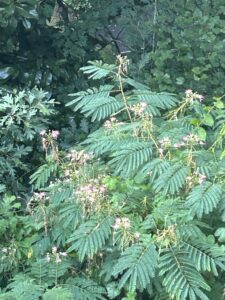
    Interesting finding was right in my backyard. When comparing the look of the Mimosa pudica, I noticed that the leaves of one tree always blooms into a pattern that is identical to Assin Manso’s Secretive Plant. Without any scientific or other professional explanation, it appears the plant was transplanted to my backyard tree.

    My backyard tree is in full bloom as a Mimosa plant descendant
    My backyard tree is in full bloom as a Mimosa plant descendant

    Like the Sensitive Plant, those stories begin to open again.

  • A Genealogist’s Packing List: Traveling Across Continents in Search of History

    A Genealogist’s Packing List: Traveling Across Continents in Search of History

    Ninety-degree heat. Forty-eight-degree cold.

    That was the reality of my journey from Accra, Ghana, to Amsterdam, the Netherlands.

    What Do You Pack for Research Across Two Continents?

    One day, I was standing under the warm West African sun in temperatures reaching 32°C (90°F). Just six hours later, I stepped off a plane into Amsterdam’s chilly spring air of 9°C (48°F), arriving at the start of the country’s largest national celebration—King’s Day.

    As I prepared for this international journey from the United States, packing became more than deciding what clothes to wear. I thought of the two continents, multiple climates, different cultural norms, and my optimistic research agenda centered on the African Diaspora and the history of the Trans-Atlantic Slave Trade.

    My international travel goals were straightforward:

    • Actively participate in mission work with my church colleagues that focused on delivery of our donated goods and service at an orphanage, school, and village in Ghana.
    • Conduct historical and genealogical research related to the African Diaspora and the Trans-Atlantic Slave Trade.
    • Experience the people, culture, and history of each destination with a focus on safety and being respectful of local customs.

    My so-called challenge was to fit everything needed for ministry, research, tourism, and everyday life into a manageable number of two checked and two carry on bags.

    What follows are the lessons I learned—and the items I am glad I packed.

    Pack Like a Researcher

    Since 2010 when I first visited Rwanda, Africa as part of my doctoral studies, I learned that research travel requires a different mindset than vacation travel. Whether visiting archives, museums, cemeteries, historical sites, or cultural sites like the botanical gardens in Ghana, researchers need tools that allow us to capture information quickly and accurately.

    My research essentials:

    • Smartphone with extra storage and internet access
    • Energy converters for plugs and other gadgets
    • Portable chargers
    • Large and small/thin notebooks and pens
    • Small cross-body bag
    • Digital copies of my passport and travel documents
    • Archive contact information and copies of permission documents to conduct research (know the protocols)
    • Cloud storage access for photos and notes
    • Activate the Whatsapp feature for telephonic and texting communication
    • Monies budgeted for copying, scanning, and other document preservation

    My two days of research in Ghana at Public Records and Archives Administration Department (PRAAD) generated hundreds of photographs, documents, and observations. I reserved some and had many scanned by the PRAAD team and delivered to me via my Whatsapp because the documents were not deliverable through my email. In Amsterdam, the celebration of King’s Day precluded me from conducting research at its libraries that stored the historical  records I was seeking. However, I was able to gather sufficient visual content related to the Trans-Atlantic Slave Trade. A future writing will delve into this with more detail.

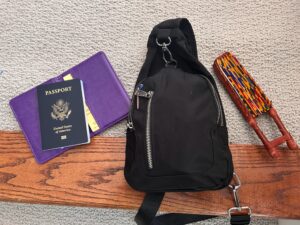
    Besides your passport, researchers should be well-armed with the essential travel items including the cross-body and a Ghanian made hand fan.
    Besides your passport, researchers should be well-armed with the essential travel items including the cross-body and a Ghanian made hand fan.

    In all, being organized matters.

    Essentials:

    • Medical vaccinations and travel medicine (if needed), forms
    • Lightweight shirts and blouses
    • Compression socks
    • Convertible travel pants — preferably blue, black, white, tan
    • Light sweater or fleece — preferably fleece
    • Rain-resistant jacket
    • Comfortable walking shoes — my preference are Crocs
    • One outfit suitable for dressy formal occasions

    Pack for the unexpected

    I learned this lesson many years ago while on a mission trip in Costa Rica: Never pack your suitcase completely full. As a research traveler, I inevitably return with books, documents, maps, gifts and souvenirs that help me remember the story.  The extra space I left in my luggage proved invaluable.  Once I brought a foldable suitcase. Another time, while in Japan, I purchased a suitcase. It was much cheaper to buy it there than in the United States.

    Great lessons

    I packed far more than clothing, my United States passport, and other travel gear. I packed my high curiosity about the once heavily traveled ship route between the Gold Coast on West Africa and the Netherlands. Those dealings resulted in the most lucrative aspect of the Trans-Atlantic Slave Trade. I packed patience and profound faith to follow history wherever it led. My luggage helped me move between continents. Those internal qualities helped me move between centuries.


  • A Fresh Scent in African Diaspora Research Found in Ghana Botanical Gardens

    A Fresh Scent in African Diaspora Research Found in Ghana Botanical Gardens

    African basil found in Aburi Gardens, Ghana, Africa
    I discovered the “Scent Leaf” or African Basil in the Aburi Gardens, Ghana, Africa

    In our African Diaspora genealogy and ancestral research, the root of our searches is often right in front of us.

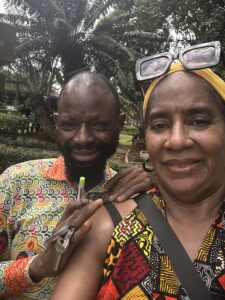
    On a recent hot Spring day while visiting Aburi Botanical Gardens — located about an hour up the cool mountain hills from Accra, Ghana — I unknowingly stepped on a leaf connected to history itself.  As I walked through the gardens with my tour guide, Maxwell, and my country escort, Prince, Maxwell paused and encouraged me to pick up a dry yellowish leaf from the ground and crush it gently in my hands.

    Immediately, a powerful fragrance rose from the leaf.

    Mint.

    Fresh.

    Alive.

    The scent startled me.

    Maxwell smiled and explained that I had just encountered the African basil known locally as “Scent Leaf,” scientifically called Ocimum gratissimum. It was among the hundreds of plant species found among the 160 acres of exquisitely beautiful lands high above Ghana’s capital city of Accra. The aromatic plant is one of hundreds of species found throughout the gardens’ approximately 160 acres of breathtaking tropical landscape overlooking Ghana’s capital city.

    At that moment, what began as tourism quietly transformed into ancestral reflection.

    The Gardens were established in 1890 during the British Colonial rule over Ghana. It became a site for agricultural exchange with British rulers and a tropical plant experimentation  center. Notable were the plants and trees tied to the former ruling empires and the displacement of people. Some of the plants and trees originated from Brazil, the Caribbean, Sri Lanka, India, and Southeast Asia.

    Fresh Scents for the descendants of the African Diaspora

    Initially, I believed that visiting the Gardens would be a nice way to end my research, mission travels involving service to young children, and touring, would be a nice way to be a tourist among the African landscapes. Yet, Abrui Gardens demonstrated its ability to allow for remembrances, recovery, and a living memory of what took place on these hallowed ground more than 100 years ago.

    Aburi Botanical Gardens, established 1890
    Aburi Botanical Gardens beauty

    Literally: Finding my Roots

    At the wise recommendations from my extremely horticulturally knowledgeable guide, Maxwell, I experienced Aburi Gardens with freedom to learn by smelling, tasting, and touching nature’s bounty. It was a form of ancestral reconnection. One of the most powerful realizations from Aburi Gardens is that genealogy does not exist only in documents.

    Sometimes genealogy grows from the ground itself.

    Maxwell is a trained horticulturist in Aburi Botanical Gardens, Accra, Ghana, Africa

    What I did was walk through most of the 160 acres of colonial plant routes and learned about the indigenous knowledge systems that turned plants and trees into medicinal usages. I encountered plants and tree that allowed me to feel and see the shaping of daily African life and diaspora survival. The smelling of the mint, for example, gave me echoes of the trade routes that financially benefited worldwide capitalists who found synthetic solutions from African origins.

    It was an experience for the ages.

    Bringing the everyday African Diaspora researcher into the Gardens

    For researchers exploring African Diaspora ancestry, Aburi Gardens offers important African Diaspora historical clues:

    • Established during colonial rule, the gardens became part of imperial agricultural systems that transported crops throughout the African Diaspora world.
    • Plants originating in the Caribbean, South America, and Asia reveal trade routes tied to colonial expansion and human displacement.
    • Indigenous medicinal traditions preserved in Ghana may echo healing practices later carried throughout the Diaspora.
    • Nearby Aburi communities, cemeteries, mission schools, and oral histories may contain valuable connections to colonial-era families and migration patterns.

    For descendants of the African Diaspora, the gardens offer more than beauty.

    Reflection in the Gardens

    My visit to Aburi Botanical Gardens became more than I expected. It was a reminder that Africa still speaks through its landscapes, plants, and people. Sometimes the stories of our ancestors are not hidden in distant archives. Sometimes they are waiting quietly beneath our feet. And sometimes, all it takes is crushing a single leaf in your hand to awaken memory.

    In all, there is a lot more to explore involving Aburi Gardens and the African Diaspora connections. I will follow up in future blogs.


  • Before You Open the Archive: The Unspoken Rules of Research Travel

    Before You Open the Archive: The Unspoken Rules of Research Travel

    Mind your manners while researching historical records
    Mind your manners while researching historical records

    From Accra to ancestral cemeteries, what every African Diaspora researcher should know about preparation, respect, and cultural awareness

    1. Plan in Advance

    A visit to a research center—whether a library, museum, park, or cemetery—requires clarity of purpose. Know what you are looking for so that staff and guides can assist you effectively.

    Example:
    When I visited Public Records and Archives Administration Department (PRAAD) I had already reviewed their policies and knew that colonial African Diaspora records were housed there.

    At a cemetery, my local escort (whom I affectionately call my “son”) understood that I was searching for graves of colonizers and Africans from the 19th century. Because of that clarity, our guide led us directly to relevant sites.


    2. Stay Organized

    Once your objectives are clear, be prepared to capture information efficiently.

    Bring:

    • A notebook
    • Writing instruments
    • Your mobile phone
    • Extra notepaper

    Example:
    Always ask permission before taking photographs. Many archives restrict general photography, but staff will often guide you on what is permitted.

    Also, never underestimate the value of a portable phone charger—it is essential.


    3. Practice Courtesy—Always

    This seems simple, but it is not always practiced.

    Example:
    I once observed a visitor who refused to present identification required for accessing special collections. His behavior disrupted the environment and ultimately led to his removal.

    Also, avoid negotiating fees for copies or services. These costs are typically fixed and governed by institutional or government policies.


    4. Be Flexible

    Research processes—especially abroad—do not always align with Western expectations.

    Patience, adaptability, and respect for local workflows will serve you well every time.


    5. Dress Appropriately

    Dress comfortably but respectfully.

    In warmer climates—especially near the equator—light clothing is helpful, but modesty still matters. Interestingly, many research facilities use strong air conditioning or large fans, so carrying a light jacket or sweater is wise.

    Example:
    I once wore shoes without proper support while navigating cobblestone streets in a European city. By evening, I paid the price.

    In hot climates, bring a hat or scarf—not only for sun protection but also for unexpected rain.


    6. Always Carry Identification

    This cannot be overstated.

    Example:
    In one instance, a visitor delayed an entire line while searching for identification. In another, refusal to present ID resulted in removal from the facility.

    Do not let something so simple hinder your research.


    Tipping all hotel staff is appropriate if allowed
    Tipping all hotel staff is appropriate if allowed

    7. Understand Tipping Etiquette

    Gratuity practices vary widely across cultures.

    Example:
    While guided tours often warrant a tip, cultural norms must be respected. In Rwanda, I tipped a driver for a long journey, only to later learn that accepting tips conflicted with local expectations. The driver went to great lengths to return it.

    When in doubt—ask.


    8. Show Appreciation

    If your research requires overnight stays:

    • Tip hotel staff( when appropriate
    • Leave notes of appreciation if tipping is not feasible

    Small gestures go a long way in enhancing your overall experience.


    9. Decompress When Needed

    African Diaspora research can be emotionally and spiritually intense.

    Example:
    If your eyes begin to blur or your heart feels heavy, pause. When I encountered records describing the execution of an ancestor, I had to step away and regroup.

    There is strength in knowing when to take a break.


    Final Thoughts

    There are many more lessons I could share—and I am always eager to learn from others’ experiences as well.

    The ultimate goal is simple: to achieve your research objectives with as few obstacles as possible—while honoring the spaces, the people, and the histories you encounter.

    (Original writing by blog author, Dr. Ann; Ai editing assisted).

  • “Uncovering African Roots: The Fascinating Link Between Twin Births and Ancestry Heritage” Keywords: Twin births, African roots, Heritage, African heritage, Genetic link, Ancestry DNA

    “Uncovering African Roots: The Fascinating Link Between Twin Births and Ancestry Heritage” Keywords: Twin births, African roots, Heritage, African heritage, Genetic link, Ancestry DNA

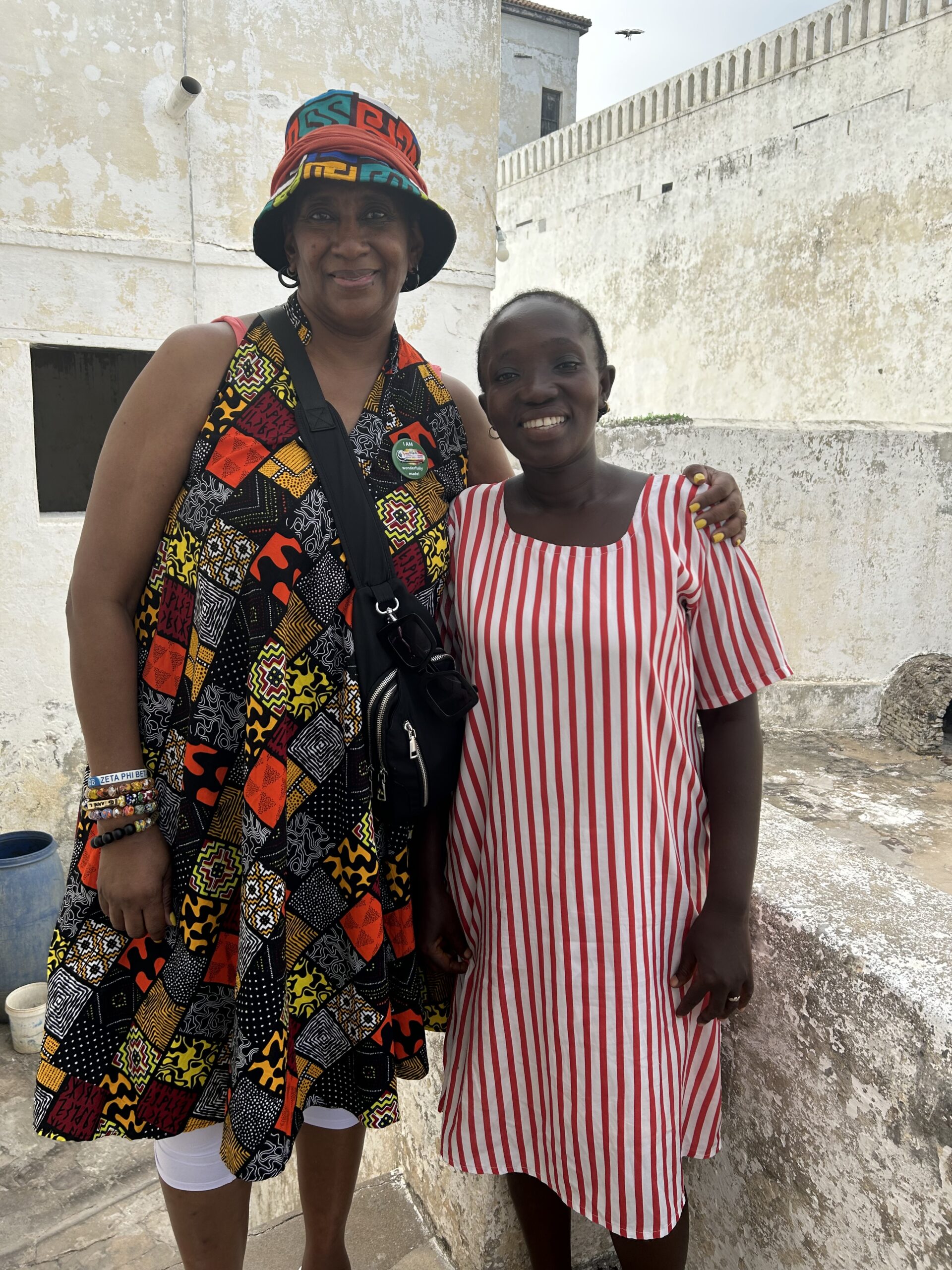
    Mothers of fraternal twin children: From left, Blog Author Ann aka Ama (born on Saturday)  and "Abena" (born on Tuesday) at Elmina (Ghana) Slave Dungeon
    Mothers of fraternal twin children: From left, Blog Author Ann aka Ama (born on Saturday) and “Abena” (born on Tuesday) at Elmina (Ghana) Slave Dungeon

    Who knew that giving births to fraternal twins would be a strong linkage to connecting African Diasporan families? Do twins “run in your family?”

    In African diasporan genealogy, I’ve found several clues that live within me as a fraternal twin mother, and within so many other African, African American, Brazilian, Caribbean women.  In short, twin births are the highest among Black women in these regions of the world. By contrast, fraternal twin births are low in Europe and the lowest in East Asia.

    I’ve been curious about the birth of twins since my boy and girl set were born some forty years ago at Georgia Baptist Hospital in Atlanta, Georgia USA.  Each time I’ve visited Africa since 2010, I’ve met mothers of twins, family members of twins, and of course, twins. The intersting feature is that often fraternal Black twins — that is, not identical ones — do not necessarily have similar outward features. I have a sense that some combinations of people are twins and that is how I often make such connections on USA, Caribbean and African soils.  On an April 2026 visit to Ghana’s Elmina community, I easily located a mother of fraternal twin children (pictured, on right). She, too, had a boy and girl twin who were soon to celebrate a milestone birthday.

    Diaspora Connection

    The same regions in West Africa known for higher twinning rates are also regions where many our enslaved Africans ancestors were trafficked from. It is interesting that elevated rates of fraternal twins among African-descended populations in the U.S., Caribbean, and Brazil. I met groups of people from northeast Ghana who are connected to Brazil.

    This is more than a statistic—it is continuity. Even after the forced enslaved passages across the Atlantic Ocean where we are still piecing together generations of separations, something remained.

    Fraternal twinning that is mostly linked to West African ancestry is a huge genealogy search clue. This inherited trait traveled across generations during the Trans-Atlantic Slave Trade and still appears in families today. For genealogists that include me, and for all family researchers, twin births are helping to trace maternal lines.

    This means that we can reconnect with our ancestors through another familial linkage and remind us that even when records are long gone, our fraternal twin ancestry leaves a wonderful mark.

    Twins as Genealogical Clues

    As we comb through government and other historical records, be on the look out for the following clues about your family that will likely help to further identify African geographical and genealogical linkages:

    • Two children listed with the same age and date of birth in early Census records;
    • Probate, plantation, church and other social documents referring to “twins”;
    • Oral family stories about the “two born together”; and
    • Repeated twin births on maternal sides of our families.

    I’ve located twins on my paternal and maternal family lines based on the connection of birth dates. It is shoring up my family’s linkage to West Africa.

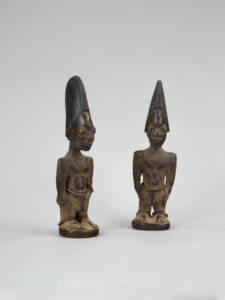
    In most of West Africa, the birth of twins is considered a significant sign from the gods. Amongst the Yoruba they are thought to bring good luck -- St. Louis Art Museum
    In most of West Africa, the birth of twins is considered a significant sign from the gods. Amongst the Yoruba they are thought to bring good luck — St. Louis Art Museum

    More Than a Coincidence

    For those who are interested in the science of twinning, fraternal twins happen when a woman releases more than one egg during ovulation. Research shows this occurs more often in some West African populations than anywhere else in the world. That means it may not be random when repeated twin births occur in a family line—especially across generations.  Our ancestors and today’s Black families often remark that “twins skip a generation” or something similar when explaining the phenomenon of twin births within families.

    For instance, my maternal grandmother gave birth to fraternal twin daughters. Skipping a generation, I birthed fraternal twin children — John and Jocelyn.

    Several recent studies track twin births in West Africa. According to a study of data from 135 countries by the University of Oxford’s Christiaan Monden and his colleagues published in 2020, the Ivory Coast had a rate of 24.9 twins for every 1,000 births during 2010 – 2015.   The report found that Ghana and South Sudan had the second-highest twinning rate, each with 24.8 twins per 1,000 deliveries, followed by Liechtenstein on 24.7 per 1,000. About 1.6 million twins are now born worldwide each year.

    “The twinning rate in Africa is so high because of the high number of dizygotic twins – twins born from two separate eggs – born there.” He continued, “This is most likely to be due to genetic differences between the African population and other populations,” explained researcher Monden.

    Next steps

    We spend our time in genealogy and ancestry research searching for what was lost.  Things and people are not really lost, all are simply unrecognized.

    Twin births remind us that our ancestors left patterns, traits, and living evidence of who they were and where they came from. Even in the absence of records, the body remembers.

    Our stories are told in pairs.


  • Breaking Barriers: Uncovering the Truth Behind Obstacles in African Diasporan Research

    Breaking Barriers: Uncovering the Truth Behind Obstacles in African Diasporan Research

    Washington, D.C.-based Museum is threatened with funding cuts by the government

    Deliberate Attempts to Block African Diasporan Research

    The history of the African diaspora is a rich and complex tapestry, woven together with the blood, sweat, and tears of countless innocent Africans were who forcibly stolen from their once beautiful homes, palaces, and other grand estates. After enduring horrible conditions, they were shipped across the Atlantic Ocean and scattered across the globe. This diaspora has had a profound impact on the cultural, economic, and political landscapes of the countries where Africans were brought and has sparked a growing interest among family members on United States shores and researchers from around the globe.

    One example is that once per month, I offer a free workshop for families seeking their ancestral linkages. It has grown from approximately 20 persons to more than one hundred in-person participants.

    Intended Hinderance

    Lately, I’ve encounted not-so-surprising roadblocks. There are several intentional activities in place to further thwart legitimate research efforts by genealogists like me and dedicated family members who simply wish to trace their roots to the ancestors who are waiting for us to discover them.

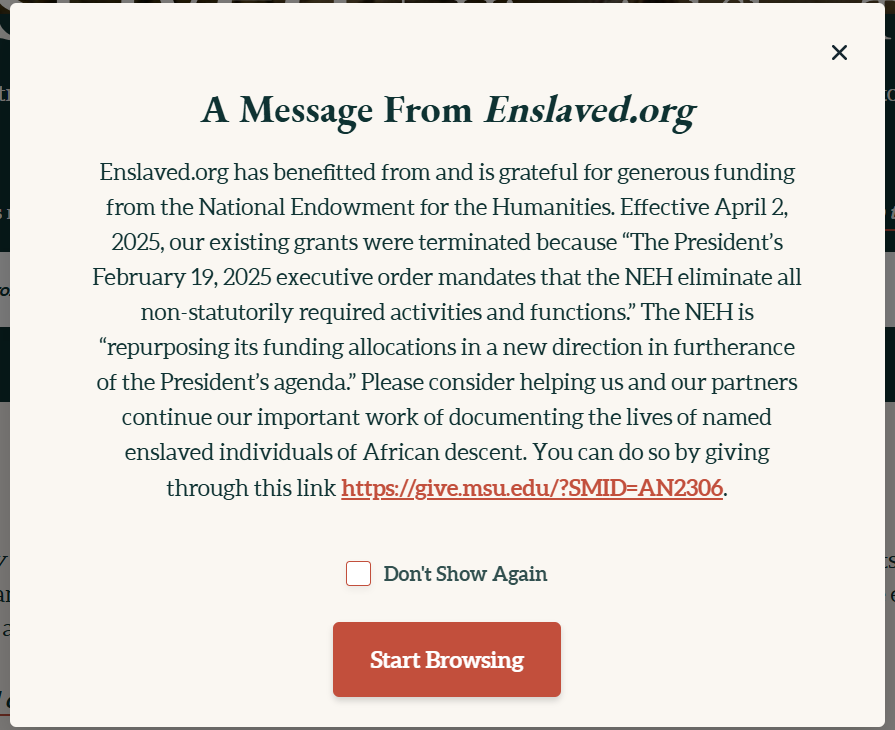
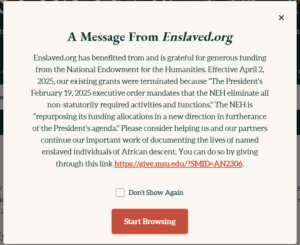
    The pop-up notice on the enslaved.org website is an example of the “new normal” that is directed from 1600 Pennsylvania Avenue, Washington, D.C.


    Enslaved.org
    Enslaved.org is the latest in several research sites that are losing U.S. funding due to new “priorities”

    There are countless other related efforts to shut down organizations that are providing information about U.S. history; Black history and African Diasporan history is U.S. history.


    Support African Diasporan research

    The deliberate attempts to block and hinder African diasporan research threaten to erase and silence the voices and experiences of those who have been historically marginalized, is unfortunate. This denial of information and knowledge not only prevents us from fully understanding our past, but also hinders our ability to create a more equitable and just future.

    We must also consider the benefits of supporting and promoting African diasporan research. By allowing diverse perspectives to be heard and studied, we open up the possibility for important and groundbreaking discoveries that can shape and enrich all fields of study. Additionally, this research can have a positive impact on communities and individuals who have been historically marginalized, by giving them a voice and validating their experiences.

    Purposeful moves to block African diasporan research have far-reaching and damaging consequences. By understanding the unique features of this subject, and acknowledging its value and benefits, we can work towards breaking down these barriers and fostering a more inclusive and accurate portrayal of our shared history.


  • Tuning into Good Vibes Genealogy

    Tuning into Good Vibes Genealogy

    Join me in listening and viewing this powerful podcast highlighting Black, African Diasporan, Indigenous, Native and American Indians and hosted by the

    Rev. Dr. LaTonia on her multimedia channels.

    What you will learn:

    • How ancestral powers transfer through the ages to affirm our purpose;
    • Personal choices involving DNA testing;
    • Indigenous U.S. tribes and its influence;
    • Prospective research sites to find ancestors; and
    • Good Genes Genealogy’s active engagement in revealing our roots.

    I’m looking forward to learning of your stories. Keep connecting with us. We value your legacies.

    Check out the "Why Didn't They Tell Us ..." podcast
    There are tons of hidden secrets about our genealogy and ancestry finds that we need to know …


  • How To Tips for Solving the ‘Two Names, One Date: The Genealogy Puzzle of Slaveholders and the Enslaved’ (Part 2)

    In earlier blogs, I shared the fairly typical challenge of separating ancestors with the same names. That is, in the case that I provided, the ancestors shared the same/similar names, birthdates and birth locations.  See below:

    Frame the research question

    Similar to planning an event, the first step in achieving desired, accurate results in ancestry and genealogy research, is to know thy primary question that requires the ultimate answer. In this case, my primary questions are:

    •  Are there two distinct individuals named Simeon Simpson born ~1833 in North Carolina—one enslaver’s son (white) and one enslaved/freed?
    • If so, — and if so, how are they distinguished and are they biologically related?

                    Working hypotheses:

      1. Two different men, same name/year, same county.

      2. Same county, hidden kinship — is the one son the product of the enslaver or enslaver’s male relative?  Who is the biological father?

      3. Different counties/communities—name coincidence only.


    Create a research log (spreadsheet) with columns: Record, Repository/URL, Jurisdiction, Date of Record, Reported Age, Implied Birth Yr, Race/Status, Household/Associates, Notes, Citation.

    Summary of my review and verification

    First, I completed another name and variant searches for Simeon/Simon/Sion/Simons + Simpson/Simson/Sampson/Sambson. Why?

    The early Census takers were U.S. Marshals and their contractors. They, along with ministers and clerks, wrote what they heard and not what was correct. There are also regional accents that caused names to be spoken that usually sounded differently in other areas.

    Also, the post-Civil War/Reconstruction period showed many deliberate name changes. The same is true during and after the Great Migration.

    • Phonetic spelling: Census takers, ministers, or clerks wrote what they heard, not what was “correct.”

    • Low literacy: Many ancestors could not spell their own names consistently, so others wrote it down for them.

    • Regional accents: A name spoken in one county or state might sound different elsewhere.

    • Deliberate changes: Some families altered spellings after migration or emancipation.The

    • Phonetic spelling: Census takers, ministers, or clerks wrote what they heard, not what was “correct.”

    • Low literacy: Many ancestors could not spell their own names consistently, so others wrote it down for them.

    • Regional accents: A name spoken in one county or state might sound different elsewhere.

    • Deliberate changes: Some families altered spellings after migration or emancipation.

    • Pull 1850 & 1860 population schedules for all white Simeon Simpson candidates; build Track A timeline.

    • Identify Simpson slaveholding households in 1850 & 1860 slave schedules; list enslaved males with ages 14 & 24 (±2) to match 1836/1842…1833 birth window.

    • Request probate/estate packets for those Simpson slaveholders; extract any enslaved “Simeon.”

    • Search Freedmen’s Bureau labor contracts in that county for Simeon attached to a Simpson employer.

    • Search Freedmen’s Bank for Simeon (Simpson) with NC birthplace; capture kin/former owner details.

    • Pull 1866 Cohabitation register for the county; look for Simeon and partner; note former owner.

    • Locate 1870 census entries for Black/Mulatto Simeon (Simpson/variants) in same county; map neighbors (FAN).

    • Check USCT and Confederate military files for men named Simeon/Simon Simpson b. ~1833 NC; note physical descriptions and next of kin.

    • Build the comparison table and update as you add records; highlight evidence of intersection or separation.